The prepaid card ecosystem has matured from an alternative payment method to a strategic imperative for modern financial institutions. The prepaid card and digital wallet market for Asia Pacific region was valued at US $ 753.8 billion in 2024, and is projected to reach about US $ 1.21 trillion by 2029 (CAGR 9.6%). This exponential trajectory underscores prepaid cards evolution from a niche product to a cornerstone of modern payment infrastructure.
Issuer-Acquirer Operational Framework
With prepaid cards at its core, some of the key components of this ecosystem include the Cardholder, the Merchant, the Issuing Bank, the Card Network, and the Acquiring Bank.
Issuer banks are financial institutions that issue payment cards to consumers and authorize transactions by verifying account balances or credit limits before approving purchases. While, Acquirer banks are financial institutions that enable merchants to accept card payments by routing transactions through card networks and settling funds into merchant accounts.
ISSUER BANK
VS
ACQUIRER BANK
Manages cardholder's account, issues cards, authorizes based on wallet balance

Manages merchant account by onboarding businesses to accept cards.
Loads balance and handles incoming money (reloads, top-ups) and tracks balances.

Handles transaction routing from merchants to the card networks.
Responsible for regulatory compliance like KYC, AML, fraud monitoring.

Settles merchant funding and handles money going out to merchants.
The prepaid card ecosystem operates within the same technical infrastructure as traditional card products, yet demands distinct operational considerations.
Issuer Acquirer Transaction LifeCycle With Card Networks
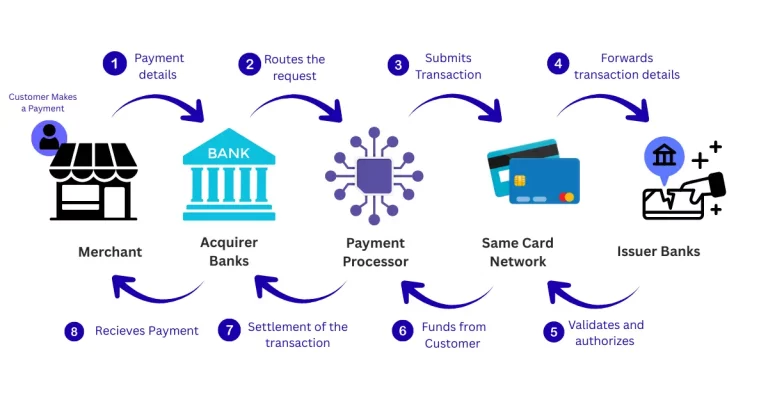
- With Same Network
When issuer and acquirer operate within the same network (e.g., both on Visa or both on Mastercard), transaction flows maintain optimal efficiency with direct authorization pathways, reduced latency, and streamlined settlement cycles.
- With Different Network
In scenarios where networks differ (e.g., Visa-issued card on Mastercard-acquired terminal), the acquiring bank routes transactions through cross-network settlement mechanisms. The acquirer’s network forwards requests to the issuer’s network, which then communicates with the issuing bank for authorization. This introduces additional settlement layers but maintains functional integrity.
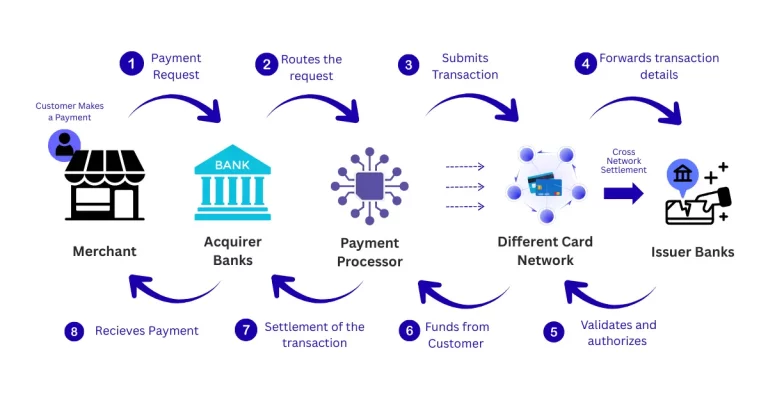
This issuer-acquirer transaction lifecycle, whether with the same-network or cross-network, processes prepaid card transactions identically to traditional debit and credit cards for authorization and settlements. Furthermore, Prepaid cards now serve a wide range of banking and financial use cases across consumer and corporate ecosystems.
Prepaid Card Use Cases Across The Banking Ecosystem
- Financial Inclusion
- Unbanked/under-banked population penetration
- Youth and student demographics requiring budget management tools
- Gig economy disbursement infrastructure
- Government benefit distribution mechanisms
- Corporate Use Cases
- Payroll card programs for hourly/contract workers
- One campus one card for University Student
- Employee expense management and per diem disbursement
- Vendor payment cards for B2B transactions
- Cobranded Cards and Loyalty Programs
- Travel Loyalty program card
- Gift card solution
- Ecommerce membership card
- Cashback program card for Food delivery
- Pharmaceutical industry
Prepaid Card Offerings Within The Card Ecosystem
Prepaid cards are rapidly emerging parallel to debit and credit cards, diversify their card offerings. With White-Label and co-branding strategies, Prepaid card programs enable financial institutions to:
- Expand addressable market without traditional underwriting overhead.
- Deploy rapid pilot programs with minimal infrastructure investment.
- Access vertical-specific customer segments (travel, healthcare, retail).
- Generate interchange revenue from previously unbanked populations.
Key Operational Aspects For Market expansion
The prepaid card and digital wallet market in APAC is projected to grow at a CAGR of 9.6% from 2025 to 2029, expanding from approx. US$ 753.8 billion in 2024 to about US$ 1.21 trillion by 2029. This growth mandates major operational frameworks including:
- Real-time fraud monitoring systems.
- Network resilience and downtime mitigation.
- Customer service infrastructure for cardholder support
Conclusion
With major card networks like Visa, MasterCard, American Express, Green Dot, and NetSpend dominating the market, alongside tech-forward companies such as PayPal and Apple reshaping the competitive landscape, institutions must evaluate their positioning within this infrastructure.
The prepaid Card sector represents multi-trillion dollar market scale with double-digit transaction volumes CAGR growth. Prepaid cards are unlocking previously unaddressed demographics while serving existing customer bases. Regulatory Compliance frameworks are constantly evolving alongside product innovation. iServeU operates as a Tier 2 regional specialist across APAC markets, leveraging its NPCI and Visa certified partner status to deliver BaaS for regional banks through a low-code integration platform that accelerates prepaid program deployment.
Author

Sai Sarthak Rout, Product Manager - Card Issuance
Payments product professional focused on prepaid card innovation and ecosystem enablement. Experienced in building and scaling card platforms across banking and fintech environments, spanning onboarding, KYC, transaction orchestration, reconciliation, and partner integrations. Actively explores emerging trends in prepaid instruments and digital payments to drive practical, customer-centric product outcomes.