Most people put UPI and CBDC on the same pedestal, assuming they will compete with each other. They’re not. Let’s make it clear from the start: UPI is a payment rail. CBDC is central bank money, issued digitally. One moves money. The other is money.
However, this raises even harder questions. Are UPI and CBDC solving the same problem? If I can pay through UPI to anyone, from anywhere and instantly, where exactly does CBDC stand? Does it make my payment experience any better? Or is it solving a problem I don’t even know I have?
That’s what we will explore here. The concept behind the scenes, the difference, if it affects you, and what evolution it will bring to already existing payment methods.
Two Different Questions, Two Different Answers
Unified Payment Interface (UPI) is the brainchild of National Payments Corporation of India (NPCI) regulated by Reserve Bank of India (RBI), introduced to Indian payment system in 2016, to replace cash dependency, simplify bank transfer and to drive financial inclusion. The frictionless system promised a blazing-fast, interoperable rail for moving already existing money, using any app. UPI solved a movement problem.
The Central Bank Digital Currency (CBDC) is a digital form of a country’s fiat currency issued and regulated by its central bank. In the case of India, CBDC is digital form of rupee itself, it’s a direct liability of the RBI. You are holding sovereign currency, digitally, the same way you hold cash. Still in its ongoing pilot stage in India, CBDC has recorded more than 150 million transactions worth over ₹34,000 crore.
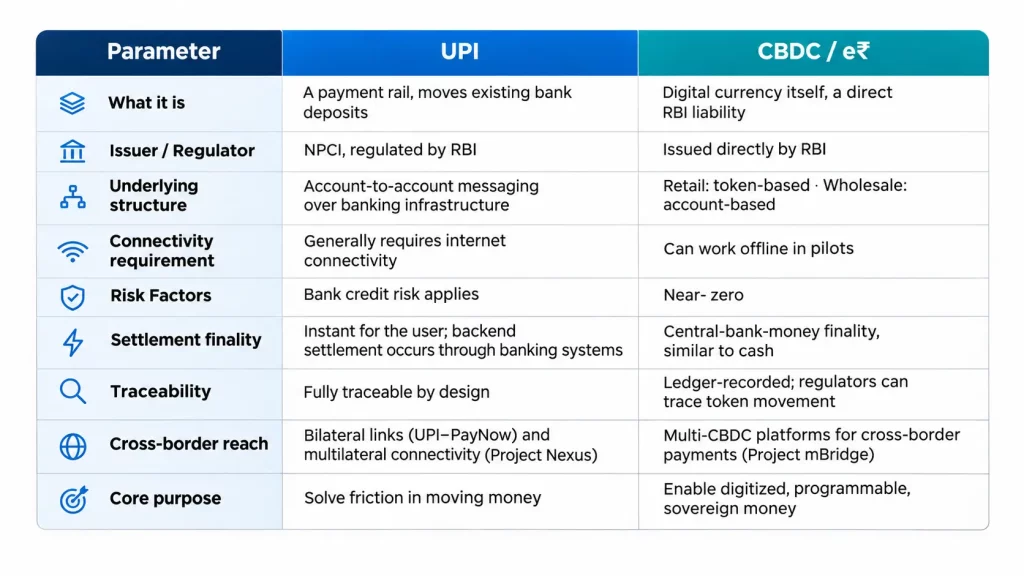
The Key Distinction: Is CBDC different from UPI?
We all have a coherent idea on how UPI works, but CBDC, the emerging counterpart, silently solving the problem you didn’t know you had. UPI works because it sits on top of India’s banking system (Indian banks, RBI-regulated). Your money is a liability on your bank’s balance sheet, and that liability is simply reassigned from your account to the receiver’s account, at their respective banks.
CBDC breaks that chain structurally. e₹ can be structured broadly in two categories – account based and token based. Wholesale e₹ is for banks and financial institutions to settle large transactions and asset transfers, faster and with less risk. Because the parties involved are known, regulated entities, RBI built this on an account-based model: identities are verified, balances are tracked, and a transfer only clears once both sides are confirmed.
Retail e₹ is for ordinary users. It has two variants. In account-based access, every transaction is approved only after verifying the user’s identity. In token-based access, the token itself carries the value. The approval happens through public-private key pairs and digital signatures instead of identity checks.
Features of the CBDC Pilot
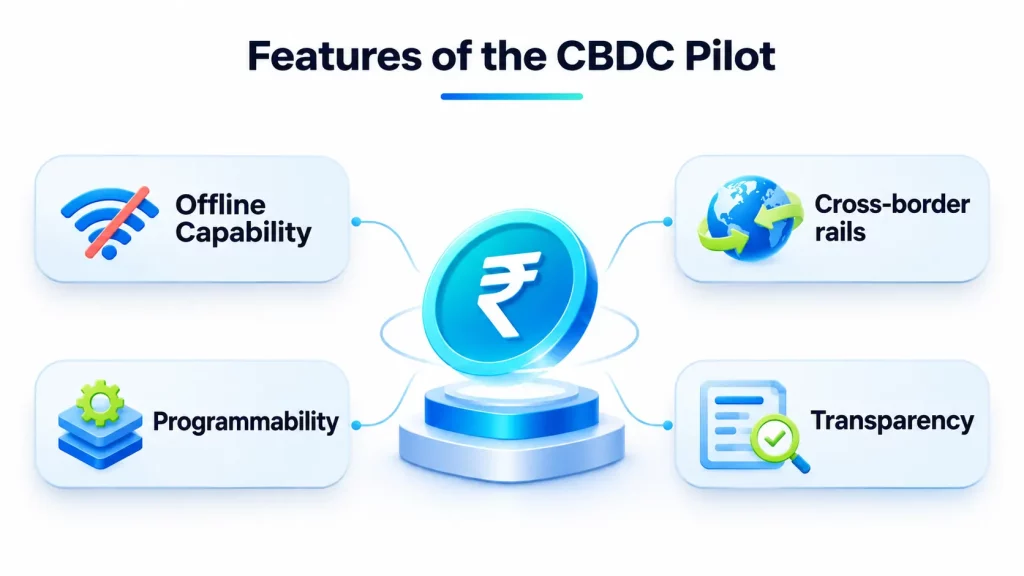
- 1. Offline Capability:
UPI, at its core, needs connectivity. RBI has been testing offline transaction capability for e₹, which matters enormously for financial inclusion in low-connectivity regions, a genuine gap UPI hasn’t fully closed.
- 2. Cross-border rails:
RBI’s 2025-26 annual report confirmed it’s pursuing bilateral and multilateral cross-border CBDC pilots. It has signed a digital-asset cooperation pact with Singapore, and is advancing pilot discussion with the UAE and other jurisdictions, largely to fix the turnaround time and cost problems in remittances, an area where India, as the world’s largest remittance recipient, has enormous stakes.
UPI has made cross-border progress too (UPI-PayNow with Singapore, for example), but wholesale CBDC gives central banks a cleaner mechanism for direct interbank settlement across borders without correspondent-banking friction.
- 3. Programmability:
RBI has already piloted programmable e₹ for Direct Benefit Transfers, for instance, food subsidies in Gujarat, Puducherry, and Chandigarh, where the digital rupee issued to a beneficiary can only be spent at designated ration shops.
- 4. Transparency:
Every CBDC transaction is recorded on a central digital ledger, which gives regulators far better visibility into money movement than cash ever offered. Every token’s movement can, in principle, be traced back through the system. For governments and regulators, this is one of CBDC’s quieter but more consequential advantages: not just digitizing money, but digitizing the paper trail that comes with it.
Compete or Complement?
On the surface, it might seem like the two systems are competing. However, CBDC shares surface similarities with UPI but caters to a fundamentally different purpose. e₹ wallets can now scan and pay into any existing UPI QR code. For instance, in disaster prone areas or low network zones, CBDC can act as a supplement. A functioning CBDC layer gives the country a sovereign fallback that doesn’t share that failure mode, simply because it isn’t routed through the same banking infrastructure UPI depends on.
The Takeaway
UPI and CBDC are completely different things. UPI solved the frictionless money transfer between two banks. CBDC is solving the digitization and programmability of money. What to choose? The smartest strategy isn’t about picking a side. It’s about understanding the problem you want to solve. CBDC is positioned to bring evolution to the economy but it was never meant to replace UPI.
As India’s payment infrastructure evolves alongside CBDC, UPI continues to be where most transaction volume lives. Discover how iServeU is helping banks and fintechs stay ready for what’s next.
Author

Dibendu Saha
Payments product professional, driving end-to-end product strategies and leading development across platform integration, compliance, transaction processing, and scalable digital payment solutions.