The UPI ecosystem is responding to a major policy shift. NPCI has announced a MDR on Person-to-Merchant (P2M) UPI transactions above ₹2,000. The reactions have been sharply divided. Some analysts project everyday users will be unaffected; others say it marks the end of “zero-cost UPI”.
UPI processed 2,451 crore transactions worth ₹29.9 lakh crore in August 2026 (Finance Ministry FAQ, Q14). That works out to nearly 80 crore transactions a day . More than 95% of P2M payments are ₹2,000 or less, so they stay free. On the rest, industry estimates suggest the new MDR could bring in ₹15,000 to ₹20,600 crore in annual revenue. So who’s actually affected, and who benefits? Let’s break it down.
The Evolution of MDR on UPI
MDR on UPI isn’t something new. Nearly a decade after UPI’s launch, NPCI reintroduced MDR on selected transactions. Until 2020, MDR of up to 0.30% applied to UPI P2M transactions, before a zero-MDR mandate took effect. (via amendments to Section 10A of the Payment and Settlement Systems Act, 2007, and Section 269SU of the Income-tax Act, 1961).
During the UPI’s zero-MDR era (2020–2026) MDR simply didn’t exist for merchants, but the ecosystem’s costs were covered by government subsidy instead. NPCI’s 2026 framework reintroduces that settlement-layer deduction for the first time in UPI’s merchant-facing history, but bounded to high-value transactions.
NPCI's New UPI MDR Rules 2026
NPCI’s revised UPI MDR framework, notified under the amended Payment and Settlement Systems Act, 2007, takes effect October 15, 2026. Here’s what it covers:
- MDR of 0.4% is applied only on P2M transactions over ₹2000, capped at ₹300 for transactions of ₹75,000 and above.
- A flat ₹5 fee (not percentage-based) applies to railways, telecom, insurance, and fuel payments above ₹2,000.
- Mutual funds, securities, and stockbroker payments attract a lower 0.02% MDR, also capped at ₹300 per transaction.
- P2P transfers remain free, as do P2M transactions up to ₹2,000, covering roughly 95-96% of total UPI P2M volume. Small merchants receiving up to ₹1 lakh/month via UPI QR stay exempt regardless of individual transaction size, and UPI QR payments in rural and semi-urban areas remain free.
- 5% of total MDR collections will go toward a dedicated fund supporting UPI adoption among small merchants, particularly in Tier 3 and smaller markets
Who Has to Pay the New UPI MDR Charges?
The MDR is paid by merchants, and only by some of them. It applies to person-to-merchant (P2M) payments above ₹2,000, so anything up to ₹2,000 stays free even for larger businesses.
Small vendors are protected under the P2PM (Person-to-Person-Merchant) framework. A merchant receiving up to ₹1 lakh a month through UPI QR pays zero MDR, whatever the size of an individual payment, and doesn’t need a GST registration to qualify. Acquiring banks and PSPs monitor this limit. If a merchant’s UPI receipts stay above ₹1 lakh for 3 consecutive months, they are moved to the P2M category, where 0.4% applies to each payment above ₹2,000.
Customers pay nothing. Person-to-person transfers, including self-transfers, remain free, and so do UPI AutoPay mandates for bills, subscriptions and recurring investments. Payments made with credit cards or credit lines linked to UPI follow separate credit product rules, so this MDR doesn’t apply to them.
Note: It’s a merchant-facing fee. NPCI has stated that merchants onboarded under the framework cannot pass the MDR on to customers, and UPI apps are similarly barred from introducing a platform fee tied to this change.
Who Benefits From the New MDR? Banks, PSPs and the UPI Ecosystem
MDR calculation is based on transaction value. For instance, a ₹3,000 payment attracts ₹12 in MDR at the 0.4% rate; a ₹50,000 payment attracts ₹200. However, past ₹75,000, the ₹300 cap takes over regardless of how large the transaction gets. So a ₹1,00,000 payment, which would mathematically work out to ₹400 at 0.4%, is instead capped at ₹300. And anything under ₹2,000 stays completely free of MDR.
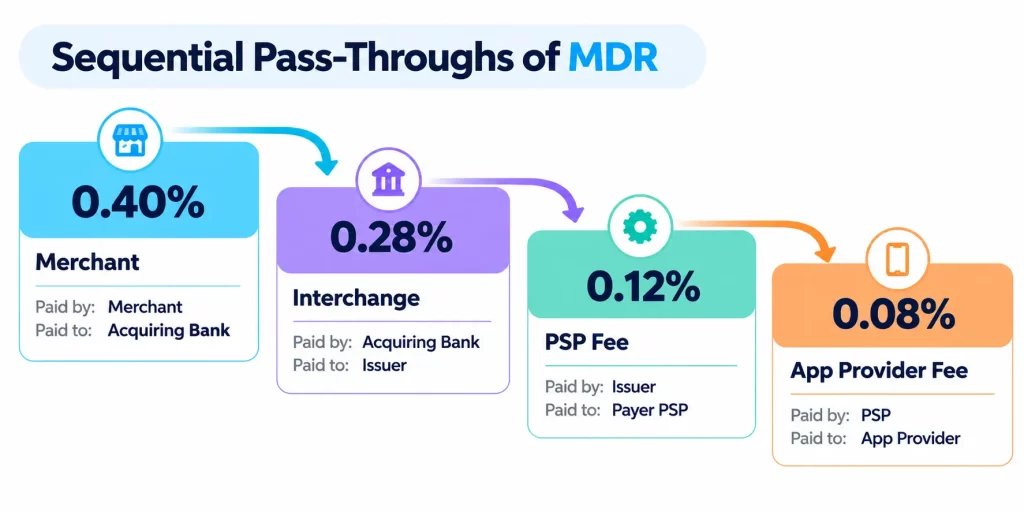
Government has clarified that MDR on UPI is not of form of tax by government or NPCI. So, who gets the MDR? The above table demonstrated how MDR cascades through these 4 players of UPI transaction ecosystem.
How the money flows:
Now, the MDR doesn’t stop at merchant paying the total MDR to the acquiring bank.
- Merchant → Acquiring Bank: The merchant pays the full MDR (up to 0.40% of transaction value) to its acquiring bank at settlement.
- Acquiring Bank → Issuer Bank: The acquiring bank pays 0.28% (as interchange) to the customer’s issuing bank.
- Issuer Bank → Payer PSP: The issuer bank pays 0.12% (as PSP fee) to the payer-side Payment Service Provider (PSP).
- Payer PSP → App Provider (TPAP): The PSP pays 0.08% to the app provider — the UPI app the customer actually used (e.g., PhonePe, Google Pay, Paytm).
Conclusion
The new UPI MDR, effective October 15, 2026, changes who funds the system that moves billions of payments every month. Larger merchants will pay 0.4% on payments above ₹2,000, capped at ₹300, while small merchants, everyday users and person-to-person transfers stay free. The money is shared among issuer banks, acquirers, UPI apps and PSP banks, and NPCI has proposed a fund to help bring smaller towns and small merchants onto UPI. For consumers, nothing changes at checkout. For merchants and fintechs, the next few months are about adapting, and how they handle it will show whether UPI’s growth keeps up now that it has a price.
As the ecosystem adjusts to this shift, the institutions that adapt quickly will be best positioned for what comes next. Explore how iServeU is helping banks and PSPs navigate UPI’s evolving cost structure.
Author

Debashis Mohapatra, Chief Operating Officer
He brings over a decade of payments industry experience to the role. He has designed and implemented merchant payment infrastructure solutions across India's financial institutions, focusing on scaling payment access for all market types. His approach to payments architecture prioritizes operational resilience and pragmatic solutions over conventional approaches.